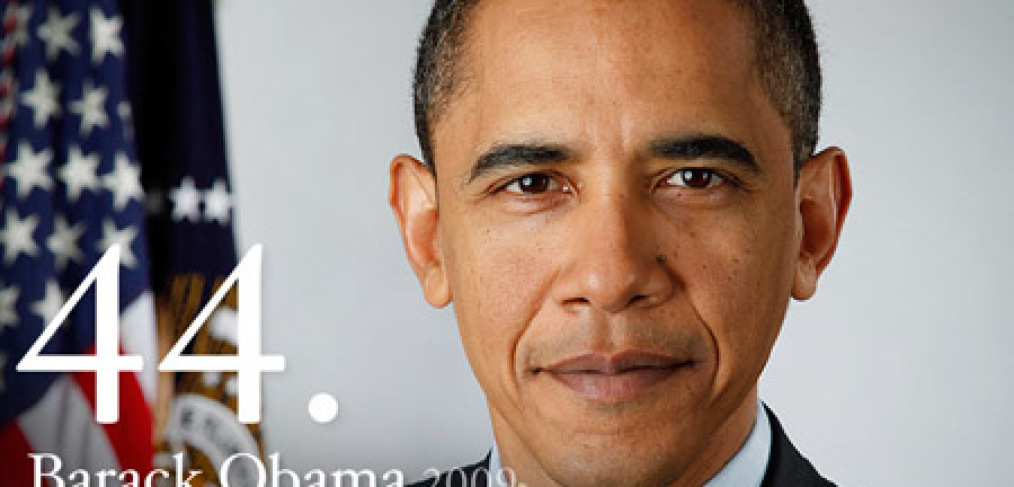
Picture courtesy of the Whitehouse.
I know this post is a little late to the game, but I figured I’d still share my thoughts on the matter, because President Obama continues to make many of the write decisions with his digital campaign.
Many experts felt that Obama won the 2008 presidential election by winning the youth vote. He facilitated a highly effective grass-roots campaign strategy by which he was able to reach thousands.
Popular social media platforms were the virtual conversion sites where Obama’s digital team advertised a plan for America to undecided voters. Appealing video speeches and Web tidbits advocating Obama’s plan for America helped to style the soon-to-be President as a political icon.
As with any campaign, it’s a numbers game; and with the 2012 Presidential election, nowhere is this more the case than in the social media universe. Long gone are the days when users logged on to the Web just to check inboxes, submit federal resumes to prospective employers or deliver e-greetings during the holidays. Today, people look to the Internet to inform more life-altering decisions, including who will become the next President of the United States.

President Obama participating on the Reddit Community – Ask Me Anything. From his Twitter Account.
Sounding Off The Social Media Way
Social Web accounts are soundboards through which users broadcast their boisterous opinions, sometimes with unwanted effects; the plethora of political rants are creating an “unfriending” epidemic. Nevertheless, political rants often introduce new or formerly disengaged voters to the candidates and their issues at large.
Passionate political pundits, who are commonly suspicious of big news establishments, collaborate with online friends and associates to scrutinize statements and verify facts, hoping to change the political leanings of their friends and associates in the process.
Social Media Campaigning
It has become abundantly clear that effectively utilizing social media is no longer an option for today’s political campaigns; it’s a necessity. Having experienced tremendous success in this area, at the start of the 2012 campaign season Obama’s team swiftly moved to fortify their social media base with Web-specific content. On the other hand, Romney’s campaign has not been as engaged with social media tools, and his overall popularity numbers have suffered as a result.
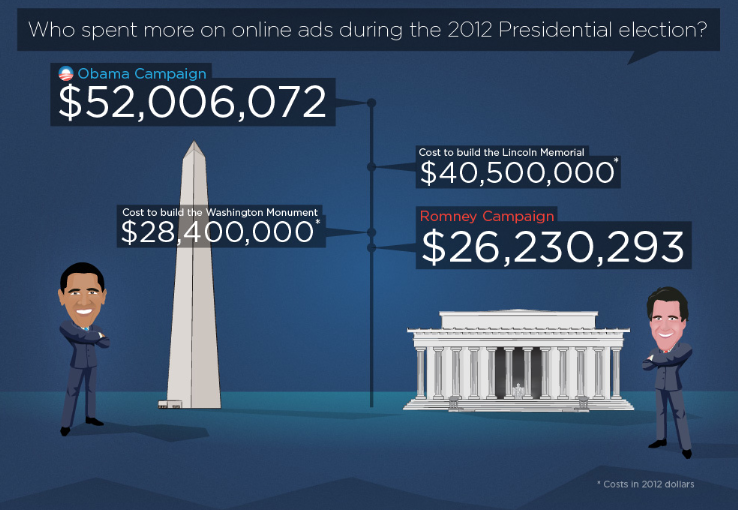
Obama Spent More on Online Ads During the 2012 Election – Facts courtesy of Business Insider.
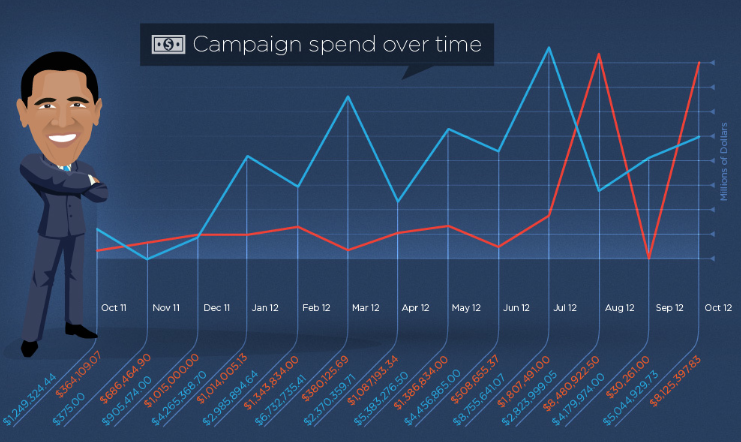
Obama Spent More Over Time. Images and Data courtesy of Business Insider
Win the Web, and You Win The War
The aftermath of the first 2012 presidential debate is proof that given enough social Web buzz, an unpopular campaign can turn around literally overnight. In spite of major media organizations attempting to declare an undecided winner, users took to social media platforms to voice an overwhelming consensus that Romney actually won the first debate. Conscientious observers took to fact checking, while thrill-seekers produced and devoured slapstick viral content that overwhelmingly showed a strong preference for Romney over Obama.
Perhaps now the “Grand Old Party” will get hip to social media’s powerful ability to change the political game completely. Competitors may fear Obama for his oratory skills and appeal to Web-conscious voters, but Romney has unleashed a barrage of whimsical political zingers upon which the social media masses feasted and made viral to his benefit.